
Services
ADAS Guides
What is ADAS Calibration? The complete beginner's guide to Advanced Driver Assistance Systems How Much Does ADAS Calibration Cost? Pricing breakdown by service type — no surprises ADAS Calibration After Windscreen Replacement Why recalibration is mandatory after new glass How Often Should ADAS Be Calibrated? Manufacturer schedules and when to book How Long Does ADAS Calibration Take? Typical durations per service and what affects them
ADAS — Advanced Driver Assistance Systems — includes every safety feature that helps you drive more safely: automatic braking, lane keeping, blind spot detection, and more. Calibration is the process of ensuring these systems see the road accurately.
This guide explains what calibration involves, why it matters, and when your vehicle needs it.
Modern vehicles rely on cameras, radar, lidar, and ultrasonic sensors to power safety features. These sensors must be precisely aligned to function correctly — that alignment process is what the industry calls calibration.
ADAS stands for Advanced Driver Assistance Systems. These are electronic safety features that use sensors to monitor the road and assist the driver. Common examples include automatic emergency braking (AEB), lane departure warning (LDW), adaptive cruise control (ACC), blind spot monitoring (BSM), traffic sign recognition (TSR), and parking assistance.
Most vehicles manufactured after 2016 have at least one ADAS feature. Many current models have six or more. From July 2024, new EU and UK type-approved vehicles must include AEB, lane keeping assist, and intelligent speed assistance as standard.
Each ADAS sensor has a specific field of view and detection zone. Calibration is the process of aligning that sensor precisely relative to the vehicle's centreline, the road surface, and the horizon. Think of it like aligning the sights on a rifle — if the alignment is off by even a small amount, the system will miss its target.
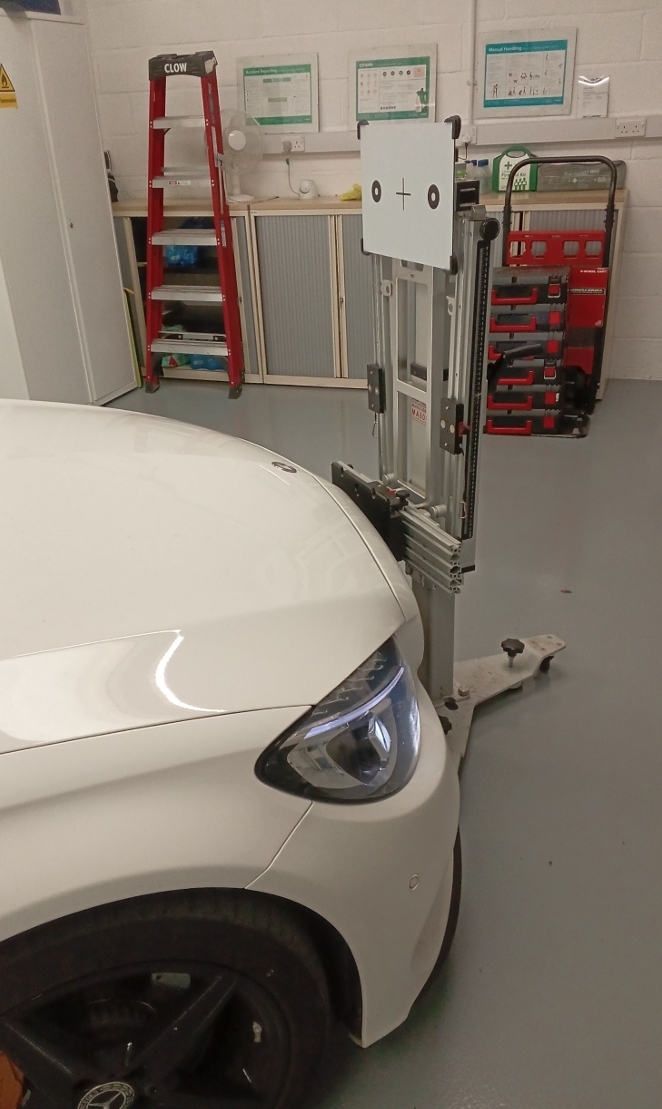
For cameras, calibration involves positioning manufacturer-approved targets at exact distances and angles, then running software that adjusts the camera's reference frame. For radar, calibration uses reflective targets to verify detection zones and distances. The process varies by manufacturer and sensor type.
Calibration is required after any event that may have moved a sensor from its original position. The five most common triggers are: windscreen replacement (affects the forward-facing camera), bumper or grille removal (affects radar and parking sensors), collision repair (may affect multiple systems), dashboard warning lights (indicates a detected fault), and gradual sensor drift from normal driving vibrations.
Some manufacturers also require calibration after wheel alignment, suspension work, or battery disconnection. Always check the manufacturer's guidance for your specific vehicle.
There are two calibration methods. Static calibration is performed indoors in a controlled workshop using precision targets — this is the most common method for camera systems. Dynamic calibration requires driving the vehicle on specific road types at set speeds so the system can self-adjust — this is used for some radar and camera systems. Many vehicles require static calibration; some need both methods.
The calibration method is determined by the vehicle manufacturer, not by the technician. Each vehicle model has a specified procedure that must be followed exactly.
An uncalibrated ADAS sensor does not just stop working — it works inaccurately. A misaligned camera might detect a lane boundary 30 centimetres to the left of where it actually is. A misaligned radar might measure following distances incorrectly. These errors compound at speed, turning safety features into potential hazards.
Research by Thatcham Research found that a windscreen camera misaligned by just 1 degree results in a detection error of 1.75 metres at a distance of 100 metres. At motorway speeds, that error is the difference between braking in time and not.
Not sure whether your vehicle needs ADAS calibration? Our team can check your vehicle specification and advise on the calibration requirements.
Answers to frequently asked questions on this topic
There is no standalone legal requirement to calibrate ADAS systems. However, driving with malfunctioning safety equipment could be considered a roadworthiness issue under the Road Vehicles (Construction and Use) Regulations. More practically, if uncalibrated ADAS contributes to an accident, it could affect your insurance claim and legal liability.