
Services
ADAS Guides
What is ADAS Calibration? The complete beginner's guide to Advanced Driver Assistance Systems How Much Does ADAS Calibration Cost? Pricing breakdown by service type — no surprises ADAS Calibration After Windscreen Replacement Why recalibration is mandatory after new glass How Often Should ADAS Be Calibrated? Manufacturer schedules and when to book How Long Does ADAS Calibration Take? Typical durations per service and what affects them
Windscreen replacement is the most common trigger for ADAS calibration in the UK. If your vehicle has a forward-facing camera — and most vehicles manufactured after 2016 do — calibration is mandatory after every windscreen change.
This guide explains why calibration is needed, what happens if you skip it, and how to make sure it gets done right.
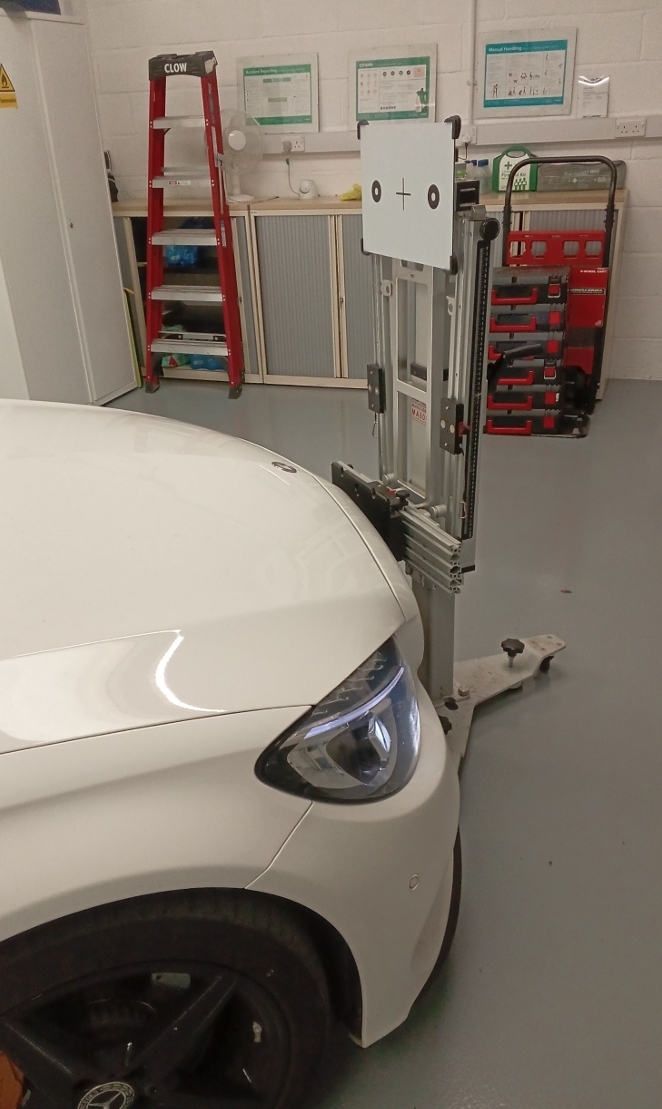
The forward-facing camera behind your windscreen powers critical safety features. When the glass is replaced, the camera's position changes — and even a tiny shift has significant consequences.
To replace a windscreen, the technician must remove the camera from its bracket, detach the bracket from the old glass, bond a new bracket to the new windscreen, and reattach the camera. Even with careful handling, the camera's position relative to the vehicle's centreline and the road surface will differ from the original installation.
The new windscreen itself may have slightly different optical properties — thickness, curvature, or tint — which changes how the camera interprets the scene in front of the vehicle. This is why calibration is required even when using an identical OEM replacement windscreen.
The windscreen-mounted camera typically powers: lane departure warning (LDW), lane keeping assist (LKA), traffic sign recognition (TSR), forward collision warning (FCW), automatic emergency braking (AEB), adaptive high beam assist, and driver drowsiness detection. All of these features rely on the camera reading the road accurately.
Without calibration, these systems may function — but with reduced accuracy. Lane departure warning might trigger too early or too late. Traffic sign recognition might misread speed limits. Automatic emergency braking might miscalculate stopping distances. The systems do not simply switch off; they work incorrectly, which is arguably more dangerous.
Some national windscreen companies (Autoglass, National Windscreens) offer calibration as part of their replacement service. However, many smaller fitters and mobile windscreen services do not have the specialist equipment required. If your fitter cannot provide a calibration certificate, you need to book calibration separately.
Even when a windscreen company offers calibration, it is worth confirming they use manufacturer-approved targets and OEM-grade software. Generic calibration equipment can produce inaccurate results on some vehicle models.
Most comprehensive insurance policies cover windscreen replacement under the glass cover section of your policy. Many now also cover the associated ADAS calibration as part of the same claim. However, some policies treat calibration as a separate charge or exclude it entirely.
Check your policy wording or contact your insurer before booking. If calibration is not covered, the cost starts from £199 including VAT. We can provide documentation to support your insurance claim if needed.
Driving without calibrating after windscreen replacement means your ADAS safety features are operating with an unknown margin of error. Research by Thatcham Research demonstrates that a camera misaligned by just 1 degree creates a lateral error of 1.75 metres at 100 metres distance. At 70 mph, that is the difference between braking for an obstacle in your lane and braking for one in the adjacent lane.
Beyond the safety risk, some manufacturers' warranties and service agreements require documented calibration after glass replacement. Skipping calibration could void your warranty coverage for ADAS-related repairs.
Had your windscreen replaced recently? Book your ADAS calibration now to restore your safety systems to full accuracy.
Answers to frequently asked questions on this topic
Ideally, calibration should be performed on the same day as the windscreen replacement. If that is not possible, minimise driving until calibration is complete — your ADAS safety features are not functioning accurately. Avoid motorway driving where possible, as the systems you rely on most at speed are the ones most affected.